

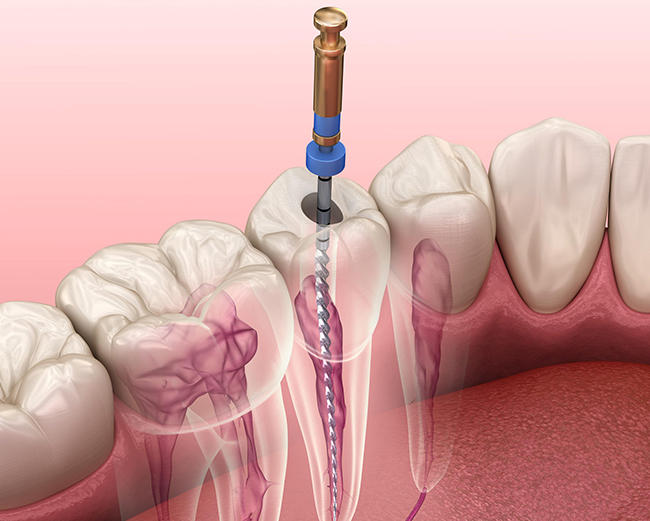
Root Canal Therapy
Dentists and endodontists typically recommend root canal therapy for one of three reasons:
- Decay has reached the tooth pulp (the living tissue inside the tooth)
- An infection occurs inside the root that creates an abscess (a dark halo that can be seen on a dental x-ray) at the root tip
- Injury or trauma has occurred to the tooth
In order to save the tooth, we remove the inflamed dental pulp (the vital tissue consisting of nerves, blood vessels, and cells) or the infected dental pulp (the non-vital tissue consisting of mostly bacteria) that lives within the root. After thoroughly disinfecting that space by various clinically-proven methods, we fill it with biocompatible dental materials.
Root canal therapy is highly successful and can last a lifetime, although it is important to follow-up with your primary dentist to properly restore the tooth with a filling or more often, a crown.
Root Canal Retreatment
In some cases, primary endodontic treatment may not work as expected for several reasons:
- The root canal space is re-contaminated by the bacteria in our saliva. This is the primary cause and usually due to:
- Failure to properly restore the tooth after treatment
- A filling or crown that leaks long after treatment
- Canals that were missed during the initial treatment because they are too narrow or curved
- There is a crack in the tooth or root and depending on the severity, it may not be a candidate for retreatment
- New decay can expose the root canal filling material to bacteria
- A small percentage of root canals simply do not heal. It is up to the skilled clinician to determine if retreatment is appropriate, in these cases
A root canal retreatment involves the removal of the previous packing material, cleansing the root canals, re-packing the tooth, and possibly re-crowning. In short, root canal retreatment is almost identical to the original procedure, aside from the structural removal.
WHY A ROOT CANAL RETREATMENT?
For most individuals, root canal retreatment is a better alternative than extraction. If a tooth has good bone support, a solid surface, and healthy gums beneath it, it stands a good chance of being saved. Opting for root canal retreatment can be far less expensive than the alternatives. Dental implants, extensive bridgework, and the creation of aesthetically pleasing prosthetic teeth cost far more than working with the natural tooth. They also require maintenance and feel less natural than a “real” tooth.
Though the prospect of more endodontic treatment might not be pleasant, root canal retreatment is fairly simple. In general, the whole treatment can usually be completed in 1-2 visits.